


High-performing workplace cultures don't happen by chance. They are built through deliberate choices like listening to employees, communicating with transparency, embedding values into everyday behaviours, and creating an environment where people feel trusted to do their best work.
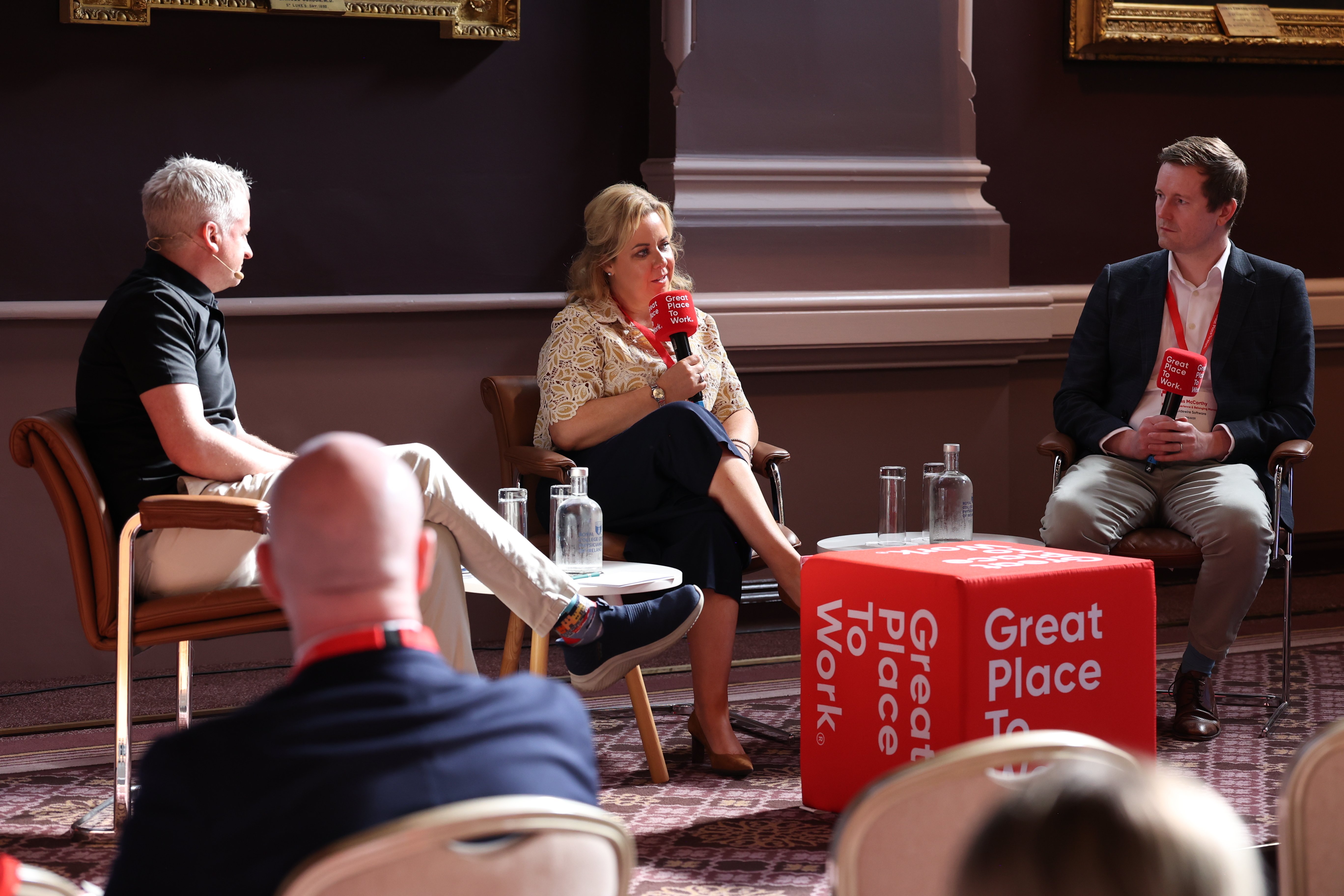
At the Great Place to Work® Employer Branding Summit, Catherine Fitzgibbon, Chief People Officer at Core, and Ross McCarthy, Employee Experience & Belonging Manager at Guidewire, explored how their organisations have built cultures rooted in trust. While their industries differ, both organisations shared remarkably similar approaches: listening to employees, embedding values into everyday practices, communicating with transparency and recognising that culture is shaped through consistent actions rather than one-off initiatives.
Great cultures begin by listening
Employee surveys provide valuable insight, but they only become meaningful when organisations use them to drive action. Gathering honest feedback starts with meaningful participation. Organisations looking to strengthen employee listening can also consider practical approaches to improving engagement with their surveys, as explored in 6 Ways to Boost Employee Survey Response Rate.
Today, Core is recognised as one of Ireland's Best Workplaces™ 2026, Ireland's Best Workplaces™ for Women 2026, and Ireland's Best Workplaces™ for Health & Wellbeing 2026. Its Great Place to Work® journey began almost two decades ago, when leadership believed they had a strong workplace culture. The survey results largely confirmed that belief, while also highlighting opportunities to strengthen the employee experience.
Employee feedback identified communication as an opportunity for improvement. While Core operates in the marketing and communications industry, employees expressed a desire for greater visibility into what was happening across the organisation, including the day-to-day updates that helped them feel connected to colleagues and the wider business.
That meant looking beyond traditional performance or commercial updates. Information about promotions, upcoming events, employee achievements and developments across different parts of the organisation became an important part of internal communication.
Effective communication is not simply measured by how often leaders send updates. Employees also need information that helps them understand the organisation, recognise the people within it and see where they fit into the wider picture.
%20-%20USE/CTAs/insights%20forum%20blog.jpg?width=420&height=420&name=insights%20forum%20blog.jpg)
Guidewire, recognised as one of Ireland's Best Workplaces™ 2026, Ireland's Best Workplaces™ in Tech 2026, and Ireland's Best Workplaces™ for Health & Wellbeing 2026, encountered a similar challenge within a global structure. Employees in Ireland were receiving communications from the company's headquarters in California, but feedback suggested that global messages were not always translating clearly into the local employee experience.
Employees are more invested in cultures they help create
Asking employees for their views is an important act of trust, but it also creates an expectation. Once people have shared their experiences, they want to know their contribution has been heard, considered and used.
This is why listening cannot remain confined to a survey cycle. Organisations need to demonstrate what changed as a result of feedback, what remains under consideration and why some requests may not be possible. At Core, employee involvement has increasingly shaped the way policies, programmes and initiatives are developed. Rather than creating a finished solution and presenting it to employees afterwards, the organisation has leaned into co-design, involving people earlier through focus groups, workshops and employee-led committees.
These sessions are used to explore how employees across different levels and teams experience the organisation. They also help Core examine whether its values and culture are felt consistently across the business or whether particular groups may be having a different experience.
%20-%20USE/CTAs/insights%20forum%20blog%20(1).jpg?width=414&height=414&name=insights%20forum%20blog%20(1).jpg)
That distinction is important. Company-wide survey results may appear positive overall while still masking pockets of the organisation where employees need additional support. Smaller workshops and level-specific discussions can help identify those differences and provide more detailed insight into what is happening on the ground.
Over time, Core’s employee committees have developed a significant sense of ownership over the organisation’s culture. They contribute ideas, recommend changes and help influence which actions are prioritised. This shifts employee listening away from passive consultation and towards shared responsibility.
Guidewire has also used feedback to make visible changes to the local employee experience. Its revised communication plan emerged directly from survey results, and the organisation has continued to explain that connection to employees. By showing that quarterly all-hands meetings, pop-up sessions and newsletters were introduced in response to employee feedback, Guidewire reinforced the message that participation could lead to practical outcomes.
For organisations, this creates a valuable cycle. Creating opportunities for employees to shape their own development and workplace experience strengthens engagement far beyond the annual survey cycle. Employees are more likely to continue sharing honest feedback when they believe doing so makes a difference. Leaders then gain better information, which can support more relevant decisions and further strengthen trust.
However, action does not always mean agreeing to every request. Some employee concerns, particularly those involving pay, overtime, resources or structural decisions, may not have a quick or straightforward solution.
Catherine, Great Place to Work® 2026 Ambassador, says that Core’s approach is to distinguish between the changes that can be made and the issues that require greater explanation. When an organisation cannot act on a suggestion, honesty about the reasons can still preserve trust. Silence, avoidance or vague promises are more likely to damage credibility than a transparent answer.
This is a broader lesson for any organisation gathering employee feedback: people do not necessarily expect every suggestion to be implemented, but they do expect a response. Closing the feedback loop is therefore as important as collecting the information in the first place.
Bringing values to life through everyday actions
Values are most influential when employees can see how they affect decisions, recognition, leadership expectations and performance. Guidewire’s three founding values – integrity, rationality and collegiality – were established before the company itself was fully formed and have remained in place for approximately 25 years. Their longevity alone, however, is not what gives them meaning.
The values are incorporated into the company’s performance review process, including self-assessments and feedback from colleagues. Employees are not evaluated solely on the work they complete, but also on how their behaviour reflects the organisation’s expectations.
Guidewire also reinforces these values through local and global recognition programmes. Employees can nominate colleagues for quarterly and annual Values Awards, creating regular opportunities to celebrate people who demonstrate integrity, rationality and collegiality in their work.
%20-%20USE/CTAs/insights%20forum%20blog%20(2).jpg?width=407&height=407&name=insights%20forum%20blog%20(2).jpg)
This has particular significance within a global and hybrid workforce. Employees who are not regularly present in the same office as senior leaders may have fewer opportunities for their contributions to be noticed informally. Structured peer recognition can help ensure that excellent work is visible across roles, levels and locations, including offices such as Dublin, Tokyo and Kuala Lumpur.
Values should be reinforced through the mechanisms employees already encounter. Performance reviews, promotions, awards, leadership decisions and peer recognition all send signals about which behaviours the organisation genuinely values.
Core’s values are similarly brought to life through the way people are expected to work together. Togetherness and making a difference are embedded throughout the organisation and became particularly important during the disruption of the pandemic.
Within a creative business, these values also support psychological safety. Employees need the freedom to propose ideas, challenge existing thinking and experiment without fearing that every unsuccessful attempt will be treated as failure.
Creativity and innovation become difficult when people are overly cautious or feel that mistakes will damage their standing. By creating room for employees to try something new, Core connects trust directly with performance.
%20-%20USE/CTAs/insights%20forum%20blog-1.jpg?width=391&height=391&name=insights%20forum%20blog-1.jpg)
This does not mean removing accountability. Instead, it means building relationships in which managers can support, challenge and stretch employees while still giving them the confidence to speak openly.
Values become credible when they are reflected in ordinary workplace systems. Statements on a wall may introduce employees to an organisation’s aspirations, but everyday experiences determine whether those aspirations are believed.
Managers bring workplace culture to life
Employees do not experience organisational culture only through company-wide initiatives. Much of their day-to-day experience is shaped by their immediate manager. This means organisations can have strong values and well-designed programmes while still delivering inconsistent experiences across teams. Managers need support in translating wider cultural expectations into relationships, decisions and behaviours. As expectations around leadership, flexibility and employee wellbeing continue to evolve, managers remain one of the biggest influences on how workplace culture is experienced day to day.
Core uses its Great Place to Work® data, focus groups and workshops to identify areas where particular teams or leaders may need support. Some issues can be addressed through practical changes, while others require coaching, mentoring or a shift in management behaviour.
The organisation also draws on its value of togetherness when leaders are struggling. Managers are encouraged to seek help from colleagues with relevant experience rather than feeling they need to solve every problem independently.
This creates an important message: asking for support is not incompatible with leadership. In a high-trust culture, managers should also feel psychologically safe enough to acknowledge where they need guidance.
Guidewire faces the added complexity of supporting offices across different countries and cultures. A practice that is effective in one location may not translate directly into another. Expectations around office attendance, communication, hierarchy and employee participation can vary significantly between markets.
Ross highlighted that managing different offices is similar to managing individuals: treating everyone in exactly the same way will not necessarily produce the best outcome. Local leaders need enough flexibility to respond to cultural context while remaining aligned with the organisation’s overall values.
%20-%20USE/CTAs/insights%20forum%20blog%20(2)-1.jpg?width=418&height=418&name=insights%20forum%20blog%20(2)-1.jpg)
This is also relevant within Guidewire’s Irish workforce, which includes approximately 36 nationalities and employees ranging from interns to those approaching retirement. Even within one location, employees may have very different expectations, needs and ways of engaging with the workplace.
Consistency should not always mean uniformity. Employees should experience the same underlying values, fairness and respect, but the way support is delivered may need to flex across teams, life stages, locations and cultures.
Discover what sets Ireland's Best Workplaces™ apart 👇

Transparency strengthens trust
Trust is tested not only when organisations have positive news to share, but when employees raise uncomfortable questions or when leaders do not have an easy answer. Creating a forum for employee questions can help make communication more open, but only when leaders are prepared to respond honestly.
Core has developed an internal “Ask Aidan” forum through which employees can submit questions to the CEO. Questions can range from simple requests to difficult challenges about the organisation, provided they are not personal attacks on individual colleagues.
As the volume of questions has grown, not every response can be addressed during an all-company meeting. Core now answers them and shares the responses on its internal platform, maintaining the commitment that every appropriate question will receive an honest and transparent answer.
%20-%20USE/CTAs/insights%20forum%20blog%20(3).jpg?width=437&height=437&name=insights%20forum%20blog%20(3).jpg)
The value of this practice is not only in the information employees receive. It demonstrates that challenging questions are allowed and that leadership is willing to engage with them.
Guidewire also encourages employees to submit questions before all-hands meetings, including through Slack. While speaking publicly in a large meeting can be intimidating, providing a digital channel can make participation easier and allow leaders to prepare thoughtful responses.
Organisations should not assume that every employee will feel comfortable raising a concern in front of colleagues. Anonymous forms, digital channels and smaller meetings can give people different ways to participate.
Transparency also depends on communication cadence. Employees are more likely to trust formal communication channels when meetings happen consistently and are not repeatedly postponed. Guidewire’s decision to schedule quarterly all-hands meetings in advance was partly about creating that reliability.
For organisations, the principle is straightforward: communication channels build trust when employees know they will be used consistently, that difficult issues will not be ignored and that leaders will explain decisions clearly.
Employee experience is becoming more personal
As employee expectations evolve, organisations are shifting away from one-size-fits-all approaches to workplace culture. While company-wide benefits still matter, employees increasingly judge their experience by how well their organisation supports them through different stages of life and work. Whether it's navigating major personal milestones, exploring new career opportunities or returning after time away, the moments that shape an employee's relationship with their employer often extend far beyond their day-to-day role.
Core has responded by developing support across key life transitions, including parenting, fertility treatment, pregnancy loss, illness, menopause and retirement. Rather than assuming every employee will need the same support, the organisation has focused on ensuring people can access the right resources when they need them most. By recognising that employees' needs change over time, Core aims to create an environment where people feel supported throughout their careers, not just at the point of recruitment.
%20-%20USE/CTAs/insights%20forum%20blog%20(4).jpg?width=454&height=454&name=insights%20forum%20blog%20(4).jpg)
Guidewire highlighted another important aspect of employee experience: creating a culture people want to return to. The organisation has welcomed around 20 "boomerang employees" back to its Irish business over the past two years, demonstrating that positive employee experiences can extend well beyond someone's time with the company. Alongside maintaining relationships with former colleagues, Guidewire continues to invest in internal mobility, helping employees build long-term careers through new opportunities across the business rather than encouraging them to look elsewhere for growth.
%20-%20USE/CTAs/insights%20forum%20blog%20(5).jpg?width=401&height=401&name=insights%20forum%20blog%20(5).jpg)
Together, these examples demonstrate that retention isn't simply about preventing people from leaving. It's about creating an experience employees continue to value throughout their careers – and one they would choose again.
Future-ready cultures invest in people
Building a high-trust culture means preparing employees for what's next. As technology, skills and workforce expectations continue to evolve, organisations that invest in learning and broaden access to opportunity are better positioned to adapt.
Guidewire is focusing on helping employees use AI to reduce administrative work and spend more time on higher-value activities, while continuing to invest in graduate programmes, internal mobility and initiatives such as its Women's Returner Programme and partnership with AHEAD to support graduates with disabilities entering the workplace. These programmes have not only expanded access to talent but also encouraged the organisation to strengthen its own hiring practices and workplace accessibility.
Core echoed the importance of creating opportunities for growth by encouraging employees to move across teams, explore new ideas and develop their careers within the organisation. Combined with a culture that promotes psychological safety and flexibility, these opportunities help employees continue learning as the workplace evolves.
Ultimately, both organisations reinforced the same message: preparing for the future isn't just about adopting new technology. It's about continually investing in people, creating opportunities to grow, and ensuring workplace culture evolves alongside changing employee needs.
About Great Place to Work®
Great Place to Work® is the global authority on workplace culture. We help organisations quantify their culture and produce better business results by creating a high-trust work experience for all employees. We recognise Great Place to Work-Certified™ companies and the Best Workplaces™ in more than 60 countries. To join the thousands of companies that have committed to building high-trust company cultures that help them attract, retain and take care of their people, contact us about getting Certified today.

%20-%20USE/RESOURCES/Webinars/Sales%20Webinar/October%202026/Sales%20Webinar%20October%202026%20event%20resource%20(2).png)
%20-%20USE/RESOURCES/Webinars/HR%20Webinars/Employment%20Law/FU%20hr%20Webinar%20September%202026.png)
.jpg)
.jpg)
-1.png)
 Blog
Blog